Take a Romanian truck that delivers a load to Poland on Monday and stands empty on Tuesday. A Polish shipper has a load from Poznań to Łódź. Can the truck take it? Yes, if it has not already done three cabotage jobs since the international delivery, if the job is finished within seven days of that delivery, and if the truck is not in a four-day cooling-off in Poland.
Three operations, seven days, then four days off
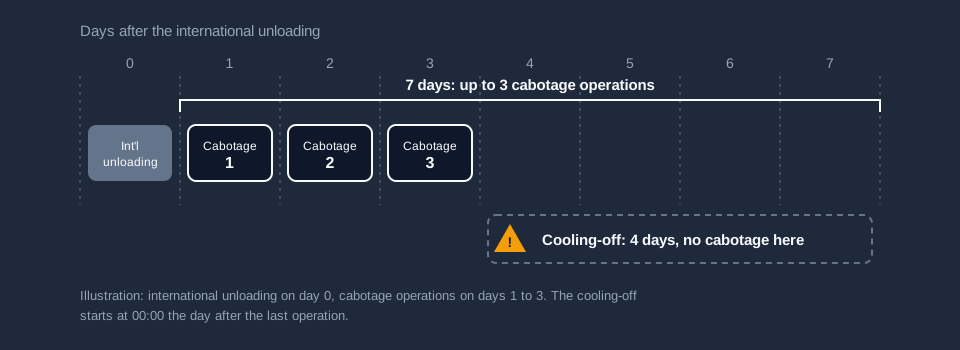
Cabotage is national transport for hire or reward carried out temporarily in a host Member State by a carrier established elsewhere (Regulation (EC) 1072/2009, Article 2(6)). After an international delivery into that country, the same vehicle may perform up to three cabotage operations, and the last unloading of the last one must happen within seven days of the last unloading of the international load (Article 8(2)). The Commission's Q&A reads these as calendar days that start at 00:00 on the day after the international unloading, and cabotage may start right after that unloading, even the same day.
The three operations can be done in the country where the international trip ended, or in other Member States, with a limit: in each of the other countries you get one cabotage operation within three days of entering it unladen.
After the last cabotage operation, the same vehicle may not perform cabotage in that Member State for four days. That is the cooling-off, Article 8(2a), introduced by Regulation (EU) 2020/1055. The four days start at 00:00 the day after the last unloading of the last cabotage operation there, and a new international delivery into the same country in the meantime does not shorten them. On 4 October 2024 the Court of Justice upheld the cooling-off (joined cases C-541/20 to C-555/20), while annulling one other element of the Mobility Package: the obligation for vehicles to return to the operational centre every eight weeks.
The Commission's Q&A adds a catch (question 11), taken from Regulation 1182/71. If the last day of a period falls on a Saturday, Sunday or public holiday of the host country, the period runs to the end of the next working day, and any period of two days or more must include two working days. A last cabotage operation on a Tuesday therefore keeps the truck out until Monday at 23:59, six days in practice. The same rule stretches the seven-day and three-day limits.
When the seven days are over, the truck does not have to leave the country. It simply cannot do more cabotage until a new international carriage makes it eligible again, and the four-day pause still applies.
What counts as cabotage
A cabotage operation is a national transport from loading to unloading at the consignee or consignees named in the consignment note, so one operation can have several loading or unloading points. It must follow an international carriage: that incoming transport has to be finished first, and if it has several unloading points, cabotage starts only after the last one. The international trip and the cabotage run with the same vehicle or, for a combination, the same motor vehicle. The international leg also has to be real. It cannot be a device to open the door to cabotage, and national authorities look at whether it was a genuine transport for hire or reward.
A week in Poland, and a detour into Austria
Three in seven. A Romanian truck unloads an international load in Poznań on Monday at 12:00. The seven days start on Tuesday at 00:00 and end the following Monday at 23:59. On Tuesday the truck takes a load Poznań to Łódź (operation 1), on Wednesday Łódź to Gdańsk (operation 2) and on Thursday Gdańsk to Wrocław (operation 3). All three operations are used. The truck can drive on to Germany for an international load, but it cannot take a fourth Polish load.
The cooling-off. The same truck unloads operation 3 in Wrocław on Thursday at 15:00. The four days start on Friday at 00:00 and run through Monday at 23:59. A new international load into Poland on Saturday changes nothing: the truck cannot do cabotage in Poland again until Tuesday at 00:00.
Entering empty. A Hungarian truck delivers in Slovakia on Monday, then drives empty into Austria on Tuesday. In Austria it may do one cabotage operation within three days of entry, so it must finish unloading by Friday at 23:59. That operation also has to end within seven days of the Slovak delivery, and it counts toward the overall limit of three.
Empty containers and pallets are covered by Commission question 6: carried under a transport contract such as a consignment note, they count as a cabotage operation; without one, they in principle do not. Member States may limit the number of loading and unloading points in one operation, so check the host country's rules before you rely on these examples.
Where Druma keeps the count
Druma counts cabotage per truck and per host country, never in the home country, and the planner sees for each truck how many of the three operations are used and whether a cooling-off is running; three is shown as the lawful limit, and only a fourth counts as a breach. A planned order that would add an operation appears as a projection before it happens, the board warns before an assignment that takes a truck over, the driver app shows the driver the status of their own truck, and the orders behind each count are listed as evidence. The unladen-entry rule from the Austrian example is covered too: one operation in that country, counted against the same three. Druma counts all three periods the Commission's way, from 00:00 the day after the event, and moves a last day on a weekend or public holiday of the host country to the next working day. It counts public holidays for the countries and years it has a list for, which as of November 2026 means 2026 only; with no list it counts weekends alone and shows a note. For an empty entry it assumes the truck crossed on the day of its last unloading outside the country. With an assumed Monday entry into Austria, the job must be unloaded by Thursday, or by Friday if Thursday is a public holiday in Austria. The compliance page shows how the count appears.

Proof, and the penalty
The Member State where the infringement is found decides the penalty, so look up the rules of each country you work in. The burden of proof does not vary. Under Article 8(3) a carrier can rely on the cabotage rules only if it can produce clear evidence of the incoming international carriage and of each cabotage operation, and an inspector will ask for it. Keep the CMR and the delivery proofs of every leg together, on the truck and in the office.
Sources
- Regulation (EC) No 1072/2009 on access to the international road haulage market, Article 8 (EUR-Lex)
- Regulation (EU) 2020/1055, amending Regulations 1071/2009, 1072/2009 and 1024/2012 (EUR-Lex)
- European Parliament Legislative Observatory: summary of the 2020 road transport amendments, the 4-day cooling-off
- European Commission: questions and answers on the cabotage rules applicable from 21 February 2022
- Regulation (EEC, Euratom) No 1182/71 on periods, dates and time limits (EUR-Lex)
- Court of Justice press release No 173/24, 4 October 2024, joined cases C-541/20 to C-555/20 (Mobility Package)
Facts last checked November 1, 2026